
A survey respondent said that some of the biggest problems in Broome County are: “racism, classism. homophobia, ableism.” These are problems across the country, and Broome County is no exception. Discrimination presents barriers to good health for all people.
Lack of knowledge and resources also causes gaps in health equity. Learn about how sociodemographic factors can affect health, where we may have gaps in local knowledge, and explore resources available for different groups of community members.
Are you someone who…
1. Wants to understand more about health equity?
Learn more about why equity is important to health:
What is health equity and why is it important?
2. Wants to explore health equity solutions:
Language is constantly being updated as the world and the people in it change. Learn about words or phrases that are generally considered best to use when talking about groups of people who aren’t you by reading this Guide to Inclusive Language:
APA Guide to Inclusive Language
Explore health equity strategies by watching webinars, reading blogs, or following action toolkits.
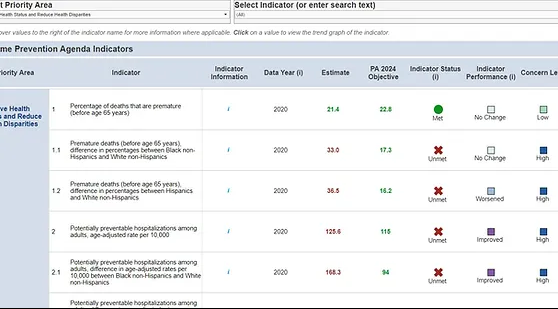
The New York State Prevention Agenda Dashboard has local data for this topic.
Click on the image below, navigate to the site, and select “Broome” from the “Select Counties” drop-down menu in the top left. In the “Select Priority Area” drop-down menu (pictured) you will find “Improve Health Status and Reduce Health Disparities.” Click on an indicator to compare Broome to other counties.
Age
Only 2.82% of 2022 Community Health Survey respondents were under the age of 18 and 13.1% were over the age of 65. These are important gaps in feedback, as children and older adults are among the most vulnerable to health challenges.
We all face different health challenges throughout our lives, and it is important to be aware of some of the dangers that we will face at different stages. Hover over the bubbles below to see some of the most common challenges facing different age groups in Broome County today.

Race/Ethnicity
The survey respondents’ racial demographics were similar to those of the county as a whole. See the county demographic profile for a breakdown.
The country and our county have legacies of discrimination on the basis of race and ethnicity. Though laws have changed to make systems appear more just for everyone, health statistics show that much more is needed to ensure that everyone has the same opportunities to be healthy.
To the right is a color-coded version of NYSDOH’s County Health Indicators by Race and Ethnicity, which shows health disparities for Broome County.
Local groups that promote health equity around race or ethnicity include:
Binghamton University Division of Diversity, Equity, and Inclusion
Gender
Survey results were biased towards female respondents. Female-identifying individuals were 68.75% of respondents, males were 28.58%. 1.2% (30 people) of survey respondents identified themselves as nonbinary, 1.5% (38) preferred not to say.
People have unique risks based on their gender. See the Health People 2030 Objectives below to learn about national health risks and goals:
| Women | Men | Nonbinary/Trans/LGBTQ+ |
|---|---|---|
Sexuality
This year we did not collect data on sexuality through our survey, and no local data exists on NYS dashboards that would help to illustrate some of the unique risks faced by the local LGBTQIA+ population.
To learn more about health risks facing different LGBTQIA+ individuals, and to view resources, navigate to:
| National | Local |
|---|---|
Education
People with degrees are slightly overrepresented in survey responses. Only 5.44% of respondents had less than a high school education when actually 7% of Broome residents do.
Healthy children generally do better in school and engage in more protective behaviors and fewer risky behaviors. Health and academic achievement are not equally accessible to all people. Lower educational attainment is associated with a number of health risks. To learn more and to view health strategies related to education, navigate to:
Economic Stability
The income of respondents was similar to the income of Broome residents. 13.3% of people in Broome County living at or below the federal poverty line.
Not having enough money can impact every aspect of someone’s health. To learn about economics and financial security, navigate to Economics. To learn more about national goals/ frameworks for change, navigate to:
Disability Status
3.26% of survey respondents were not working at the time of their response due to a disability, while the number of people living with a disability in Broome is much higher. Some disabilities are visible, and some are not. Some are present at birth, and some develop later on. Many disabilities could pose barriers to engaging with a survey like the one that we put out.
See the printable resource guide below for a list of local resources for people with disabilities:
Language
Our survey was only available in English, which means we likely did not get responses from many people for whom English is a new language or who don’t speak English at all. Most local public health educational resources, including this dashboard, are also only available in English. This is likely a barrier to health equity for 9.7% of the population of Broome County, who speak a language other than English at home.
A local resource for immigrants and community members who are learning English as a new language is the American Civic Association. Many organizations, including Broome County Health Department, use the Language Line to translate conversations with people who do not speak English fluently.
Religion
Religion plays a large part in many people’s lives and has an effect on attitudes towards different types of healthcare.
Some survey respondents expressed that religion should have a bigger role in healthcare and daily life while others think it should have less of a role. Changes you’d like to see to make it a healthier place: “more secular/ humanitarian organizations, less religion.” “The upholding of the sanctity of life from birth through natural death.” “The spreading of the Gospel and the unity of the separated brethren with the Catholic Church.”
Religious institutions often are often places where people can go for resources and for community. Find a religious institution near you:
Politics
Should we actually include? It affects the information you hear and what you trust. changes to make it healthy – “bad government officials.” “less government.” “stay out of the way and let the government decide.” problems: “Ignorance.” “Ignorance.” “Liberalism.” “Overreaching government.”


