Are you someone who…
1.Uses substances, or know someone who does?
If you or someone you know is struggling with substance use, consider calling SAMHSA’s national helpline for confidential, 24 hour/7 days a week information.
If you are looking for a treatment facility, Narcan training, or other resource, consider one of these local resource guides:
Printable Substance Use Resources (211)
Broome County Alcohol & Substance Use Services
If you are looking to drop your sharps or medication somewhere, choose a location near you:
2. Wants to know more about substance use
Mental Health and Substance Use Insurance Help
What do we know about substance use?
Substance use has deep roots in human history. Throughout our past, people have used plants or other substances to treat pain or sickness in the body and to alter mental states for spiritual or recreational purposes. Substances are a part of our regular lives and are often useful, but addiction to substances and overdoses from substances have caused a lot of suffering, especially in Appalachia where Broome County is located.
People don’t decide to become addicted. We run into addictive substances for the first time sometimes at bars or parties, sometimes through friends who are taking them, and sometimes because we were given them by a doctor to help with pain or recovery. While many substances can provide benefits in the short term, a lot of them have the potential to change a person’s brain chemistry to the point where their body needs the substances to feel normal. Substance Use Disorders (SUDs) are:
“treatable, chronic diseases characterized by a problematic pattern of use of a substance or substances leading to impairments in health, social function, and control over substance use. It is a cluster of cognitive, behavioral, and physiological symptoms indicating that the individual continues using the substance despite harmful consequences” (Substance Use Disorders (SUDs), CDC).
SUDs can cause us to act out of character. We may take risks we wouldn’t usually take, or say and do things we wouldn’t have in the past. Harmful consequences of our behaviors, like losing connections with friends and family, won’t matter as much if our brain chemistry is altered to be addicted.
In the past year, 40.3 million people aged 12 or over in the U.S. experienced a Substance Use Disorder.
Who does it affect?
Substance use disorders can affect anyone – regardless of location, income level, race, gender, education, etc. Most of us in Broome County have been affected by the issue in one way or another. Still, different people have different risks for substance use. They may, for instance, be more likely to use substances or less likely to seek help. Looking at national trends in substance use and identity may help give insights into our local situation.
Race & Ethnicity
Recently there was an increase in overdose rates for Black, Hispanic, and White US residents. The largest increase was among Black Americans and the second highest was among Hispanic Americans. Learn more
Black and Latinx people are less likely to receive treatment for substance use disorders than White people. Learn more
Mental Health
Individuals with mental health challenges are more likely to experience a substance use disorder (SUD), and vice versa. Learn more
Age
Individuals who start using substances earlier in life are more likely to abuse substances as an adult. Many youths who use substances have had adverse childhood experiences. Learn more
Gender & Sexual Orientation
Men are more likely than women to use any type of illicit drug, and are more likely than women to visit the emergency department or die from an overdose after using illicit drugs. Learn more
LGBTQ adults experience substance use disorders at higher rates than their heterosexual counterparts. Learn more
Rurality
Cigarette smoking and methamphetamine use are more common in rural areas. Illicit drug use and cocaine use are more common in large metro areas than rural ones. Learn More
Substance Use in Broome County
In Broome County, data as of December, 2023 indicates that newborn drug-related hospitalizations are elevated. Binge drinking is elevated, especially among males and adults aged 35-44 and among those with a high school diploma or less. Smoking and e-cigarette use are concerns. Though all of these issues are being addressed throughout the county, the most devastating substance use issue and the one receiving the most attention is opioid overdoses.
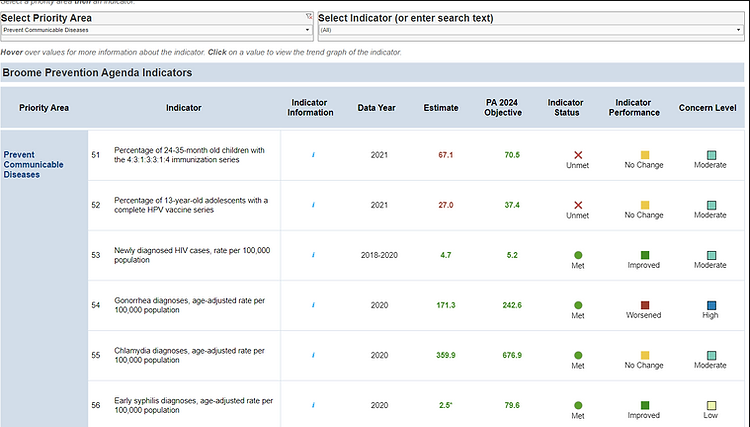
The New York State Prevention Agenda has data on this topic.
Click on the image and navigate to the page. Select “Broome” from the “Select Counties” drop-down menu in the top left. In the “Select Priority Area” drop-down menu (pictured), you’ll find “Promote Well-being and Prevent Mental and Substance Use Disorders.”
Here’s a bit of information that helps to show why substance use is a priority area in Broome County…
| 8x | 1st | 2.5x | 2.3x |
|---|---|---|---|
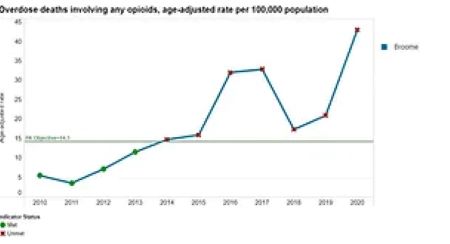
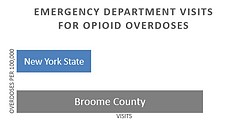
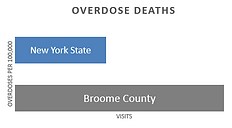
| Overdose deaths involving any opioid increased by about 8x from 2010 to 2020, from 5.5 to 43. | On the Community Health Survey, “Addiction to alcohol or other drugs (substance use disorder)” was the most commonly selected answer (65%) to the question “Please select the (5) biggest health problems you believe our community is currently facing. | Compared to New York State averages, there were 2.5 times as many visits to the emergency department for opioid overdoses in Broome County in 2016. | Compared to the New York State averages, there were 2.3 times as many overdose deaths in Broome County in 2016. |
 |
 |
 |
 |
Want more data? Take a look at these data focused dashboards:
NYS Opioid Dashboard
NYS County Health Indicator Reports
New York State Prevention Agenda Dashboard
Our Plan: Substance Use
To address substance use in Broome County, we are focusing on:
1. Reducing overdose deaths involving any opioid
Open access hours at treatment facilities
UHS has open access assessment (no appointment needed) hours at New Horizons.
MAT in emergency departments
UHS and Lourdes have developed protocols to get bupinorphne into emergency departments. UHS now has a medication-first model (low threshold), offering buprenorphine/naloxone tablets and films, as well as Soblocade and Brixadi.
Emergency department engagement
UHS has peers in the emergency department every day to assist in connecting patients to community resources.
MAT in jails and after release
UHS has implemented Medication Assisted Treatment (MAT) in the Broome County Sheriff’s Correctional Facility. They make sure that patients continue their MAT if they are arrested. In the jail, they have detoxification protocols for people who use opioids and MAT programs. When people are released from jail they can get same-day MAT.
Local organizations adopting new screening tools for substance use issues:
Alcohol Use Disorders Identification Test-AUDIT, The Drug Abuse Screening Test – DAST, Screening Brief Intervention to Treatment-SBIRT. These evidence-based tools help with early identification, intervention and referral to resources and treatment.
Expanding inpatient and outpatient recovery and rehabilitation services
Increasing the number of patient beds within Helio Health and getting future affordable housing through the NYS Empire State Supportive Housing Initiative. Expanding ACBC outpatient services – now three locations (Binghamton, Endicott, Norwich).
Expanding awareness of and services around methamphetamine use
Implementing Clearing the Confusion Education program
Zoom program for students/ parents and families of those suffering from substance use disorders.
Naloxone distribution
Through community member distribution, distribution to recently incarcerated residents, to college students, and to people who use drugs. Linkage and Retention to Care (connections to care), Harm Reduction & Stigma Reduction, Data & Trends, Provider Education, Persons Who Use Drugs, and Evaluation.
Harm reduction vending machines
At UHS, ACBC
2. Increasing the number of providers attending Buprenorphine trainings
Training Healthcare providers
Local healthcare systems collaborated to train healthcare providers in the use of Buprenorphine.
Regional trauma-informed care at schools
Care Compass Network piloted a regional trauma-informed care (RTIC) school-based transformation at two local schools, Whitney Point Caryl E. Adams Primary School and The Children’s Home of Wyoming Conference. This included staff training, curriculum enhancement for kids, trauma screening, and other interventions. A report was published to help others learn from the pilot program. The regional team published a resource guide for community health workers, along with posters on mindfulness.
3. Expanding Peer Support Services for people who use substances
Peer Response Program/ Public Safety Initiatives
ACBC recruits, trains, and retains peers to work with local law enforcement and first responder agencies. Ride-alongs. They develop and implement protocols to refer patients to services.
Peer referrals in emergency rooms
Lourdes is working on a referral pathway for patients in need of (and actively seeking) mental and behavioral health/SUD services. The pathway would allow the Lourdes Center for Mental Health to take direct referrals from primary care.
UHS New Horizons peers continue to engage ED patients providing referrals to services and Narcan trainings upon discharge.
Peers in inpatient/ outpatient clinics
Inpatient – Helio Health, UHS
Outpatient – ACBC, UHS
Community Peer Outreach
ACBC
UHS – peer support groups
Warming Center Peers
ACBC
4. Implementing prevention and response strategies by establishing 1) linkages to care and 2) working with grassroots organizations and agencies to increase harm reduction education projects
Narcan trainings
Truth Pharm, Helio Health, Southern Tier AIDS program, and UHS provide Narcan trainings and harm reduction education to community members. Broome County Health Department refers community members and organizations.
OD2A grant/ Opioid Settlement Funds
BCHD releases RFPs for community agencies. Projects include family support programs, youth prevention, community prevention, housing, supporting pregnant and parenting women programs, expansion of MOUD programs, addressing the needs of criminal justice involved persons, expanding peer services, harm reduction projects that increase access to naloxone and/or conduct harm reduction and stigma reduction education.
5. Setting up a county-wide public overdose spike alert protocol
Update the alert protocol
Community partners collaborated to create one county-wide overdose spike alert protocol.
6. Building capacity for a more effective, comprehensive and sustainable local prevention and response effort by strengthening the infrastructure of the Broome Opioid Awareness Council.
Strategic Planning
A strategic planner was hired for the BOAC committee. A strategic planning session was held in Spring 2023.
Renewed BOAC structure
Monthly subgroups will meet, with BOAC meeting quarterly. Subgroups include: Linkage and Retention to Care (connections to care), Harm Reduction & Stigma Reduction, Data & Trends, Provider Education, Persons Who Use Drugs, and Evaluation.
Do you or does your organization want to help address substance use in Broome County? Check out these evidence-based interventions: Strategies to address substance use
Contributing Organizations
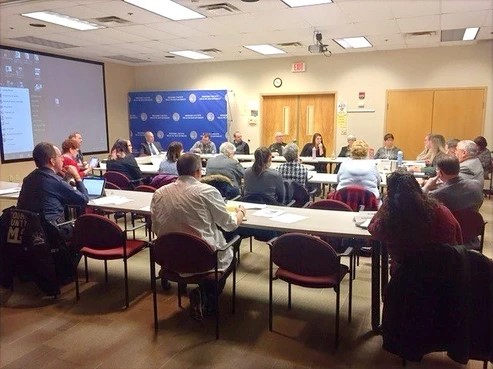
Some of the substance use work being done in our communities…
Other links:
Centers for Disease Control and Prevention | Drug Overdose Deaths Rise, Disparities Widen
Centers for Disease Control and Prevention | High-Risk Substance Use Among Youth
Centers for Disease Control and Prevention | Substance Use Disorders (SUDs)
National Institute of Mental Health | Sex and Gender Differences in Substance Use
National Institute of Mental Health | Substance Use and Co-Occurring Mental Disorders
SAFE Project | Substance Use Disorder in the LGBTQ+ Community
Yale School of Medicine | Racial Inequities in Treatments of Addictive Disorders